
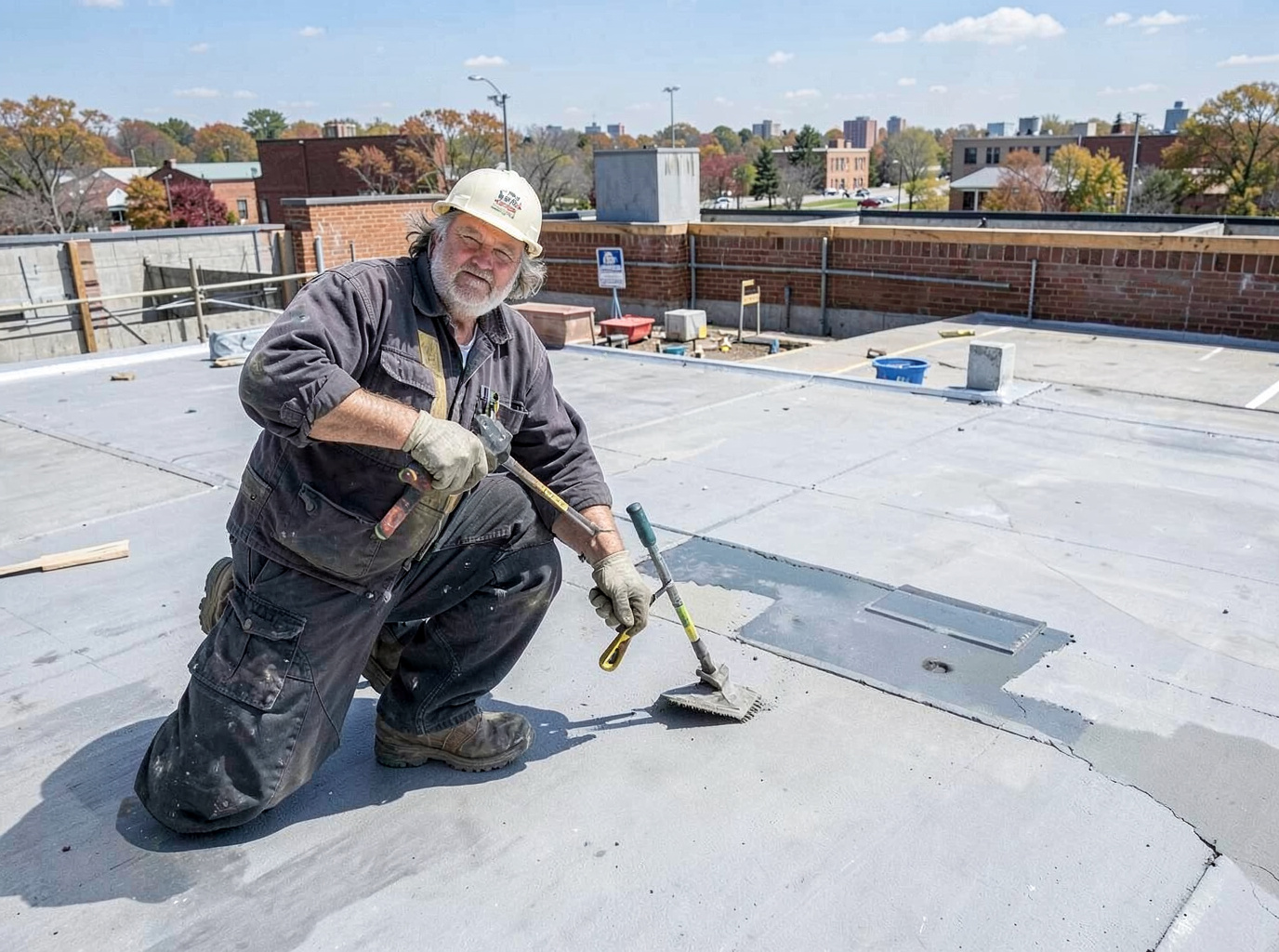
Springfield's humid continental climate brings hot summers that expand membrane seams and cold winters that contract them, often opening leaks around HVAC curbs and drains on flat commercial roofs. In neighborhoods like Downtown and Rountree, many two- and three-story brick buildings from the mid-1900s still carry original built-up or modified bitumen systems that have been patched repeatedly. A contractor working these roofs must check for ponding near parapets and confirm the existing insulation has not absorbed water from previous storms.
Repairs on flat commercial roofs in Greene County frequently involve addressing edge details where wind-driven rain from the southwest pushes water under flashings. Near Missouri State University and the Springfield Art Museum, older retail and office buildings often have gravel-ballasted systems that hide moisture until it reaches interior ceilings. Proper repair means cutting out wet insulation, installing new tapered crickets if needed, and welding or adhering new membrane patches that match the existing system without creating new seams that will fail in the next freeze.
Route 66 Car Museum and similar commercial properties along major corridors see heavy foot traffic from maintenance crews, which can damage single-ply membranes. When repairing these roofs, crews must protect existing penetrations and ensure new work meets current Greene County wind and uplift requirements. Skipping proper termination bars or using incompatible adhesives leads to recurring leaks after the first hard winter.
Technician insight
In Springfield, the thing that catches most people out with Commercial Flat Roof Repair is skipping the moisture scan. Older buildings near Missouri State University often have hidden wet insulation under the membrane from years of small leaks; if you just weld a patch over it, the rot keeps spreading through the next freeze cycle.
Rountree Office Building Leak
Water stains appeared on ceiling tiles after a heavy spring rain. Inspection revealed ponding at two scuppers and wet insulation under the modified bitumen on a 1960s flat roof. Crew removed the saturated sections, installed new tapered insulation and a welded TPO patch tied into the existing system, then cleared the scuppers. No further leaks reported after the next heavy storm.
Commercial Flat Roof Repair Services We Offer
✓EPDM Membrane Patching
Locates and replaces damaged sections of EPDM on commercial flat roofs common in Downtown Springfield buildings, restoring watertight seams that hold up through summer heat and winter contraction.
✓TPO Roof Seam Welding
Re-welds failing hot-air seams on TPO systems found on newer commercial properties near Parkcrest and Republic Road, preventing water intrusion during heavy spring rains.
✓Modified Bitumen Repair
Removes blistered or cracked modified bitumen layers on older Greene County commercial roofs and installs compatible torch-down patches rated for local freeze-thaw exposure.
✓Drain and Scupper Clearing
Cleans and repairs clogged roof drains and scuppers on flat commercial roofs to eliminate ponding that accelerates membrane breakdown in humid Springfield summers.
✓Flashing and Curb Restoration
Replaces deteriorated perimeter flashings and HVAC curb details on buildings in Rountree and University Heights to stop wind-driven water entry common in Greene County storms.
Commercial Flat Roof Repair Cost in Springfield, MO
| Service | Typical Range | What Affects It |
|---|---|---|
| Minor seam weld repair | $450–$850 | Single location on accessible roof |
| Small wet insulation patch | $900–$1,800 | Includes cut-out and new tapered insulation |
| Perimeter flashing section | $1,200–$2,400 | Depends on parapet height and length |
| Drain replacement | $650–$1,100 | Includes new drain and membrane tie-in |
Ranges are typical for Springfield, MO and confirmed with an exact written quote before any work starts.
How it works
- 1
Site Assessment
Walk the roof with infrared or moisture meter to identify wet insulation and document all penetrations on commercial buildings in Springfield.
- 2
Material Matching
Select compatible membrane and adhesives that match the existing system while meeting current Greene County wind requirements.
- 3
Targeted Removal
Cut out damaged sections, remove wet insulation, and prepare substrate without disturbing sound portions of the roof.
- 4
Patch Installation
Install new membrane, weld or adhere seams, and reinstall proper flashings around curbs and drains.
- 5
Final Water Test
Flood test repaired areas and inspect from below to confirm no active leaks before leaving the site.
Pricing
Upfront quotes after on-site inspection; price driven by roof access, membrane type, and extent of wet insulation.